
landing.cases.intake.title
landing.cases.intake.body
E-Maalkhana by Vinkura AI
Register seized property. Tag exhibits with QR codes. Log every movement. Produce court-ready receipts. One system for the station desk and the district view.
Maalkhana intelligence
Inside the portal, officers query records through Maitreyi Y1, Vinkura's own small language model for maalkhana work. Scoped to role and station. Runs on your infrastructure.
About Maitreyi Y1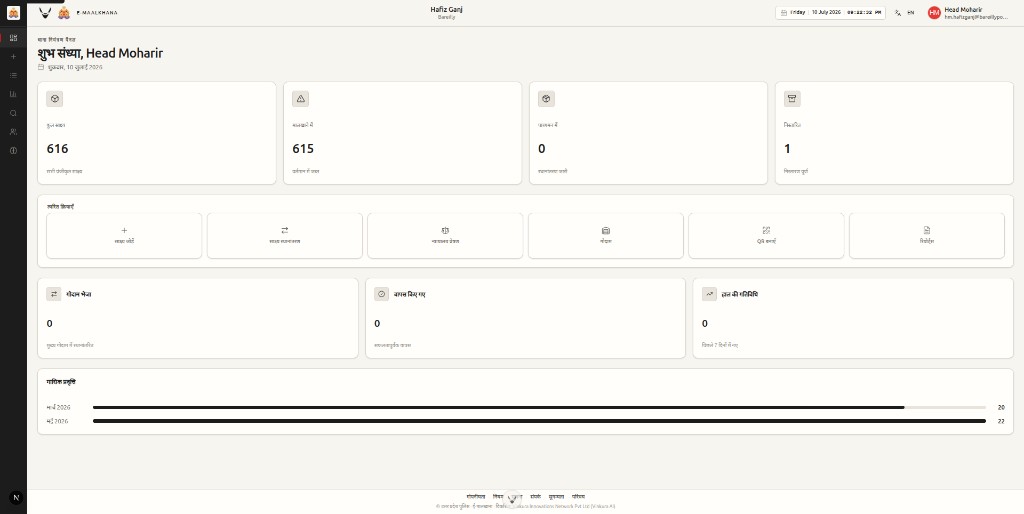
Meet E-Maalkhana
E-Maalkhana (also known as E-Malkhana) is built for how police stations handle seized property. Officers register items at intake. Every later movement stays logged, searchable, and ready for audit. Used in UP Police and other deployments.
E-Maalkhana by Vinkura AI. Maalkhana digitization for any police department.
Station dashboard from the authenticated portal
In the field
Typical outcomes from police station and district deployments. No logos, no invented awards.
landing.cases.intake.body
District administrators review exhibit status across stations from one console. Oversight no longer depends on calling each moharir for a verbal count.
When an exhibit leaves for hearing, officers generate submission paperwork with the movement log attached. The custody chain does not have to be rebuilt by hand.
Product
Screens from the authenticated portal: registration, search, reports, and maalkhana intelligence.
What is in the maalkhana now: totals, court-pending items, and shortcuts for daily work.
Evidence lifecycle
Eight stages. Each step is timestamped, attributed, and kept for audit.
Maalkhana intelligence
Maitreyi Y1 is Vinkura's own small language model, built for maalkhana records. It powers intelligence inside E-Maalkhana: officers ask in plain language, answers come from authorised data, and every session stays on your infrastructure.
Purpose-built for custody queries, storage status, and case-linked exhibit lookup. Not a public chatbot bolted onto the portal.
Open portal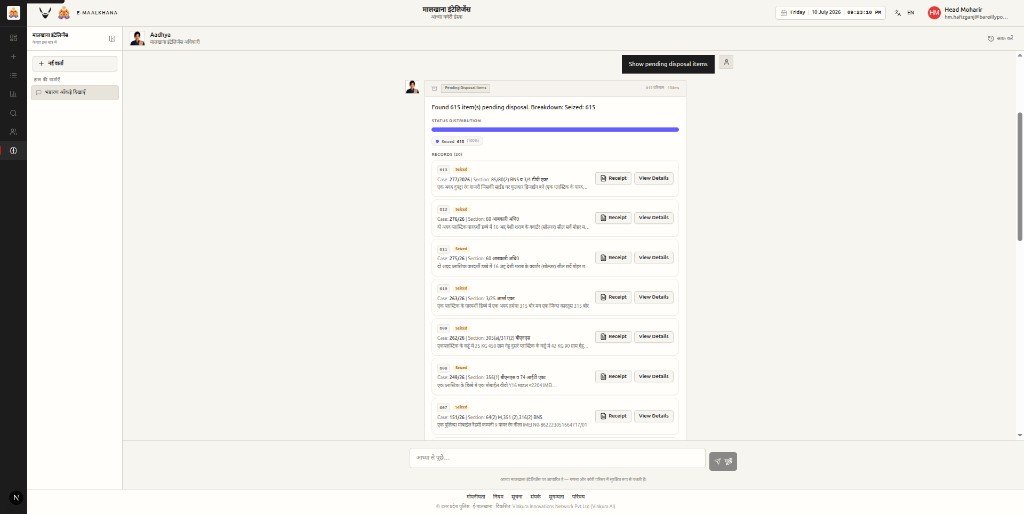
Example queries
Illustrative · Scoped to permissions after login
Pending court submissions, March 2026
23 exhibits · 8 documents · 15 electronic
Station · Authorised
Storage utilisation by category, district view
Electronics 42% · Weapons 18% · Documents 40%
District · Admin
Movement history for EM-2026-0142
3 events · Last: 06 Jan stored Rack B-3
Exhibit · Role-based
Disposal queue overdue more than 90 days
7 exhibits flagged for review
District · Audit

By Vinkura AI
Vinkura AI
Technology for government operations
E-Maalkhana is a Vinkura AI product for police maalkhana digitization. It covers exhibit registration, storage assignment, movement logs, court handover, and audit-ready reporting. Deploy on your infrastructure with role-based access and Hindi/English interfaces where needed.
vinkura.in →Vinkura portfolio
Related products from Vinkura. Details at vinkura.in.
Demos and deployment
Product walkthroughs and rollout enquiries go to Vinkura. Station portal access is provisioned through your unit administrator.
E-Maalkhana by Vinkura AI. Maalkhana digitization for police departments.
E-Maalkhana is operated under institutional access policies, not as a consumer product. If your agency is already onboarded, sign in through the station portal.
For case or evidence-related public requests, contact your local law enforcement authority, not the product team.
e-maalkhana Login →FAQ
Short answers on the product, login, and digital maalkhana for police.